Which AI Model Should Your Team Actually Use in 2026 (and Why Not to Pick Just One)

The 2026 question isn't "which model is best" — it's "which model for what"
Every few weeks, a new model launches and someone asks the same question: which one should our team standardize on? It feels like a decision you make once and move on from. In 2026 it isn't. The question sounds like "which model is best," but the useful version is narrower and more honest: which model for which task, and at what cost.
That reframing matters because the honest answer to "which is best" changes almost monthly, and because no single model is best at everything at once. A model that tops a coding leaderboard may be overkill — and overpriced — for summarizing a meeting. A model with a huge context window is the right tool for a 200-page contract and the wrong one for a quick reformat. So the goal of this post isn't to crown a winner. It's to help you match tasks to models, and to explain why locking your whole team into one model is the part that quietly costs you.
All numbers below are from primary sources and dated, because they age fast. Treat them as a July 2026 snapshot, not a permanent ranking.
The frontier at a glance (as of July 2026)
Here is a compact, current view of the models most teams are weighing right now — what each is suited for, and roughly what it costs per million tokens on the API. Prices are input → output.
| Model (provider) | Best suited for | Price /1M (in → out) |
|---|---|---|
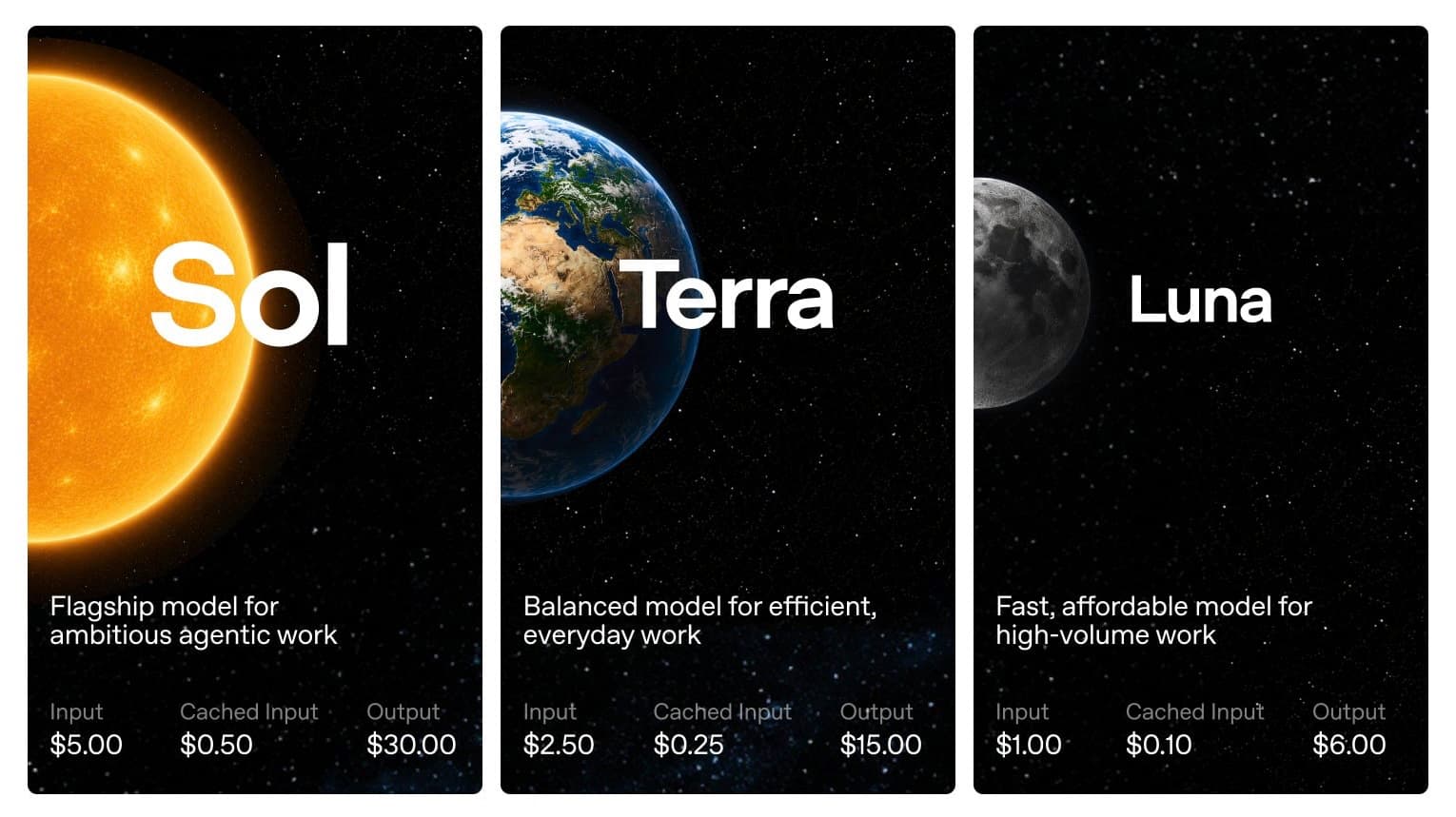
| GPT-5.6 Sol (OpenAI) | Hard reasoning, coding, and long-horizon agentic work | $5 → $30 |
| GPT-5.6 Terra (OpenAI) | Balanced everyday work at lower cost | $2.50 → $15 |
| GPT-5.6 Luna (OpenAI) | High-volume, cost-sensitive tasks | $1 → $6 |
| Claude Fable 5 (Anthropic) | Demanding reasoning and long documents (1M-token context, up to 128k output) | $10 → $50 |
| Claude Opus 4.8 (Anthropic) | Strong all-round work at half the price of Fable 5 | $5 → $25 |
| Gemini 3.1 Pro (Google) | Long-context and multimodal work, cost-effective | $2 → $12 |
Sources: OpenAI's GPT-5.6 announcement (three tiers, generally available 9 July 2026); Anthropic on Claude Fable 5 and Mythos 5 (9 June 2026, $10/$50, 1M context) and Claude Opus 4.8 (28 May 2026, $5/$25); Google's Gemini API pricing for Gemini 3.1 Pro. Note: Gemini 3.1 Pro pricing rises to $4 → $18 for prompts over 200k tokens; benchmark standings cited later come from Artificial Analysis. One important caveat on that Anthropic page — Claude Mythos 5 shares Fable 5's capabilities but is not generally available; it ships only in a restricted program (Project Glasswing), so it is not a model your team can simply switch on.
Choose by task, not by hype
Once you stop looking for a single winner, the decision gets easier, because most work falls into a handful of buckets and each bucket has a natural fit.
Hard reasoning and research. For genuinely difficult problems — multi-step analysis, tricky research, work where a wrong answer is expensive — the top tiers earn their price. As of mid-July 2026, GPT-5.6 Sol sits near the top of Artificial Analysis's Intelligence Index (score 59, #2 of 188), and Claude Fable 5 is Anthropic's most capable widely released model. These are the ones to reach for when correctness matters more than cost.
Coding and agentic work. Coding is where "best" gets specific. On Artificial Analysis's Coding Agent Index, GPT-5.6 Sol set a new state of the art at 80, narrowly ahead of Claude Fable 5 — while costing less per task. But "narrowly ahead on one index" is the whole point: the leader here is not automatically the leader on reasoning, and both change with the next release. Coding also rewards models with strong tool use and large context, which is why the Claude and Gemini families stay in the conversation.
Long documents and large context. When the task is a long contract, a dense report, or a folder of research, context window matters more than a leaderboard. Claude Fable 5 carries a 1M-token context window with up to 128k tokens of output per request, and Google's Gemini Pro line is built around long context as well. For document-heavy work, the ability to hold the whole thing at once beats a marginally higher reasoning score.
High-volume, cost-sensitive work. Classification, extraction, routine summaries, first-draft replies — the tasks you run thousands of times — are where model choice shows up on the invoice. This is what the cheaper tiers exist for. GPT-5.6 Luna runs at $1 input and $6 output per million tokens; using a flagship here instead is how AI bills quietly balloon for no gain in quality.
Speed. For anything interactive or user-facing, latency is a feature. A smaller, faster model that answers in a second often beats a larger one that thinks for ten — not because it's smarter, but because the person waiting is real. Match the model to the moment, not to the benchmark.
The pattern across all five: the right model is the cheapest one that clears the bar for that task. That's a different decision for each bucket, which is exactly why one model for everything is the wrong default.
Why picking just one model is a trap
Standardizing your whole team on a single model is appealing. It's simpler to reason about, simpler to budget, simpler to explain. It's also, in 2026, usually the expensive choice. Here's why.
The frontier moves monthly. Look at the six weeks behind this post: Claude Opus 4.8 landed on 28 May, Claude Fable 5 on 9 June, and GPT-5.6 on 9 July. Each was, briefly, near the top. Opus 4.8 launched as Anthropic's most capable model; within six weeks Anthropic had released Fable 5 above it, and on Artificial Analysis's shared Intelligence Index it had slipped to #5 of 188 (score 56). The model didn't get worse — the field moved past it. If you had standardized on Opus 4.8 in late May, you'd already be a step behind, through no fault of the model.
No model wins everything. The same snapshot shows one model leading on coding and another leading on general reasoning, at different prices, on the same day. A single standard forces you to accept second-best on most of your tasks in exchange for consistency on one.
Lock-in has a cost. Building everything around one provider's model — its quirks, its prompts, its API — makes switching harder exactly when switching would help most. The team that can move a workload to a better or cheaper model in an afternoon keeps a lever the single-model team gave up.
Cost is the quiet tax. The spread on our own table is roughly tenfold: $1 input for GPT-5.6 Luna versus $10 for Claude Fable 5. Run your routine, high-volume work on a flagship and you pay flagship prices for work a cheaper model would do just as well. Pick one model for the whole team and you're choosing, by default, to overpay on the easy tasks or under-serve the hard ones.
None of this is an argument against these models — they're genuinely strong. It's an argument against betting your whole operation on any one of them staying ahead.
The practical answer: one workspace, switch per task, see the cost
If the right model changes by task and by month, the sensible setup is a workspace that gives you several of them behind one door — so switching is a setting, not a migration. That's the case for a multi-model AI workspace: leading models from the Claude, GPT, and Gemini families in one place, instead of a separate subscription, login, and bill for each.
Two things make this practical rather than just convenient. First, the model can be chosen for you: routing can send each task to a fitting model automatically, cost-aware, so routine work lands on a cheaper tier and hard work lands on a stronger one — without anyone hand-picking a provider per message. You can also set the model yourself per workspace when a task calls for it. Second, switching models doesn't scatter your work: the folder context, uploaded files, and conversation history stay attached, so the engine changes but the grounding doesn't. This is multi-model access built for teams, not a browser full of tabs.
For an organization, the payoff is control as much as capability. Model choice becomes something you govern centrally — decide which models are available, keep usage and cost visible in one place, and avoid AI spend fragmenting across a dozen personal accounts. When the next model ships, you evaluate it and turn it on for the tasks it suits, instead of re-platforming the team. You can see the current model lineup on the models page.
To be clear about what this is and isn't: the value isn't a side-by-side benchmark theater or a claim that any one model is best. It's that the answer to "which model" can change per task and per month without the workspace around it changing at all.
Getting started
You don't need a model strategy document to start. Pick two tasks your team actually does — one hard (a real analysis or a coding problem) and one routine (a summary or a batch of replies) — and run each on a fitting model rather than forcing both through the same one. Notice the difference in quality on the hard one and the difference in cost on the routine one. That contrast, on your own work, tells you more than any leaderboard.
From there, the habit is simple: match the task to the model, keep the option to switch, and revisit when the next release lands — which, going by 2026 so far, won't be long. The teams that do well with AI this year aren't the ones who guessed the single best model. They're the ones who never had to.
Model data in this post is a snapshot as of July 2026 and will age as new models ship. Figures are drawn from the primary sources linked above; verify against them before making decisions.
See it work on your own files
Upload a file and ask a question — every answer points to the document, page, and passage it came from.